Thursday, December 1, 2011

The First Sin

Gen 3:1–19

Sin is Disobedience


God created everything perfect, and because of God’s common grace, much of the beauty of God’s creation still survives in spite of divine judgment on sin. It’s surprising to hear discussion of what the nature of Adam and Eve’s sin must have been. I’ve heard pride, lust of the eye, and so forth. The simple answer is that it was disobedience. God had given them broad latitude in the Garden of Eden, outlawing precisely one tree out of all his creation:

The LORD God warned him, “You may freely eat the fruit of every tree in the garden—except the tree of the knowledge of good and evil. If you eat its fruit, you are sure to die.” (Gen 2:16–17)

Even the Tree of Life would have been a permitted tree before disobedience. But with Satanic enticement, Eve ate from the forbidden tree; then she became Satan’s agent and got Adam to eat from the forbidden tree. Adam should have stood at that tree and come to the knowledge of good and evil by judging the evil enticer rather than falling under the serpent’s enticement.

Sin Has Deadly Consequences

The Bible depicts an immediate loss of intimacy on two levels. (1) Adam and Eve became ashamed of their nakedness before each other—something that never bothered them in their innocence before disobedience (Gen 2:25; 3:7). (2) Worse, they became ashamed and hid from God as well (Gen 3:8).

God made judicial inquires, asking what they had done. Instead of confessing their sins and repenting, they only made excuses. Adam blamed it all on his wife Eve: “I was the woman you gave me who gave me the fruit” (Gen 3:12). Eve blamed the serpent for tricking her (v. 13).

But God blamed them both for disobeying him. He told them that this sin would trouble them—and right at the point of the creation mandate. They were to fill the earth. For Eve and all her successive daughters, that would mean childbirth. The judgment on sin touched her right there (Gen 3:16). Adam was to rule and subdue the earth; however, the only crown the earth would bring him would be thorns and thistles (Gen 3:17–18).

But we can be so glad of divine grace, from the coverings God provided to Adam and Eve, to the promise that the woman’s offspring would crush the serpent’s head (Gen 3:15). Thank God the story continues with God’s gracious provision through Jesus Christ our Lord. When Jesus met with the same enticer in his wilderness temptations, he succeeded where Adam had failed. He overcame the serpentine enticer by obedience and reverence for God’s Word.

Adam’s sin brought sin into the world, and with it came death and judgment (Rom 5:12–21). But “Adam is a symbol, a representation of Christ, who was yet to come” (v. 14). One man’s sin brought death, “But even greater is God's wonderful grace and his gift of forgiveness to many through this other man, Jesus Christ” (v. 15).

Questions, Reflections, and Commitments
  • What do you think might have been the result if Adam and Eve had gone straight to the Tree of Life and eaten from it while it was still a permitted tree, rather than heading for the forbidden tree and eating it?
  • Reflect on the double force of Paul’s argument in Romans 5:12–21, which is summarized as follows: “Adam's one sin brings condemnation for everyone, but Christ's one act of righteousness brings a right relationship with God and new life for everyone” (v. 18).

Wednesday, November 30, 2011

Creation

Gen 1:26–31

GOD CREATED EVERYTHING for his pleasure, but he created humanity in his own image and likeness. Speculative proposals for what this denotes multiply:
  • Maybe it’s that we have a spirit (Heb. ruach) or a soul (Heb. nepesh); however, animals are also said to have both nephesh (Gen 1:20, 24, 30) and ruach (Gen 6:17; 7:15).
  • Some suggest that it’s the degree of human intelligence that constitutes the image; however, that explanation seems a recipe for humanitarian disasters of a Nazi-like order if it means failing to identify the fetus, infant, or mentally handicapped as fully human.
  • Some suggest that man’s use of tools constitutes the divine image in humanity; however, we now see that chimpanzees and even some sea creatures fashion and use what can fairly be called “tools.” And since I’m not very adept with tools myself, I’m not sure I like this explanation at all!*
  • Others suggest the human desire and ability to create constitutes the image. If so, it’s a strange twist that this is the very aspect of human existence that’s turned so readily against God in the crafting of images to be used for idols!
  • Others suggest that the desire for fellowship with God constitutes the image and likeness; however; however, it’s more likely that this is not what constitutes image and likeness, but hat it’s a result of our bearing the divine image.
All these suggestions ignore the fact that the creation account itself gives us the answer to the question. It defines image-bearing in the functional terms of divine appointment: “They will reign” over all creation as God’s representatives (Gen 1:26), to “govern it” (v. 28). Being God’s image and likeness has to do with being God’s royal representatives ruling over his earth on his behalf.

God also gave humanity a mandate to fill the earth. That involved more than just expanding human population but also extending paradise, so that the whole of the earth would be a paradise-like realm for God’s presence and rule.

Sadly, the Genesis account quickly turns to humanity’s fall into sin. But just as quickly, God’s note of gracious hope returns. Right after God’s judgment on Adam and Eve, condemning them to death for sin, we read a human note of hope: “Then the man—Adam—named his wife Eve, because she would be the mother of all who live” (Gen 3:20). And the very next verse we see a divine note of grace: “And the LORD God made clothing from animal skins for Adam and his wife” (v. 21). The line of God’s image and likeness would continue after all—and with divine protection and provision.

Lest we think that humanity no longer bore God’s image and likeness after the judgment for sin, the next great judgment (the flood) is also followed by a note of divine commitment to man serving as the divine image and likeness: “If anyone takes a human life, that person’s life will also be taken by human hands. For God made human beings in his own image” (Gen 9:6). This condemns violence against the very image of God. But it also reaffirms the authority of human beings to rule—even in capital cases.

Adam and Eve were created as prototypes of divine rule through human rep-resentatives. Later this pattern came to a degree of fulfillment in David and his dynasty. Of course, all of this could only be a limited version of what will happen through the one who is “the visible image of the invisible God,” not as God’s creation, but as the one who “existed before anything was created and is supreme over all creation” (Col 1:15).

“The Scriptures tell us, ‘The first man, Adam, became a living person.’ But the last Adam—that is, Christ—is a life-giving Spirit” (1 Cor 15:45). And when he comes forth from the grave, he will live and reign forever. God called on human beings to subdue the earth (Gen 1:28); and all things will be put under Jesus’ feet (1 Cor 15:27; Eph 1:22). And as renewed image of God (Col 3:10) the saints will share in that reign (2 Tim 2:12; Rev 20:6), for which humanity was created in the first place (Heb 2:8).

Questions, Reflections, and Commitments
  • How might you and your family be more faithful to the mandate to live and reign over creation as God’s image and likeness? Remember that ruling, subduing, and filling was not just about making a paradise, it was about extending the realm of God’s presence and power in the earth through representative rule.
  • Today when you pray, “May your Kingdom come son,” may you continue with the words of that prayer which constitute both an explicit request and an implied commitment: “May you will be done on earth, as it is in heaven” (Matt 6:10). Make it a request, “O God, manifest your rule through my life.”

____________
*Depending upon the context, ruach means everything from “spirit” or “Spirit” to “wind” or “breath.” Similarly, nephesh, refers to means to the “soul,” the “self,” a “life,” or a “being/creature,” or even the “throat.”

Tuesday, November 29, 2011

Re-blogging Jesse Tree series

I'm re-blogging the Jesse Tree series. I'm just re-posting each of the lessons in a series that I posted for Christmas 2009. I'm not sure how we'll they're updating on my blog, though. If you come into them from my facebook page, you come to the right lesson each day; however, if you just come to my blog, it looks like you comes to the last of the series, no matter what day.

Introduction to Jesse Tree

Isaiah 11:1–10


THE BIBLE SAYS, “God chose [Jesus] as your ransom long before the world began, but he has now revealed him to you in these last day” (1 Pet 1:20 NLT). In fact, God says, “Even before he made the world, God loved us and chose us in Christ to be holy and without fault in his eyes” (Eph 1:4 NLT). God was working his plan of salvation long before Jesus was born in Bethlehem.

Jesse had seven sons. Some of them may have seemed impressive sorts to Samuel, whom God had sent to anoint one as king. But God told Samuel, “Don’t judge by [their] appearance or height…. The LORD doesn’t see things the way you see them. People judge by outward appearance, but the LORD looks at the heart” (1 Sam 16:7 NLT). In fact, God had chosen Jesse’s youngest son to become Israel’s greatest king. David was the first royal branch from “the Jesse tree.”

This family tree held great messianic promise, through thick and thin. The promise of an eternal Davidic dynasty stood true whether Israel and the Davidic dynasty measured up to God’s expectations or not. Even when the Davidic kings broke covenant with God, God’s promise to David and his descendants still stood. So Isaiah could promise, “There shall come forth a shoot from the stump of Jesse, and a branch from his roots shall bear fruit…. In that day the root of Jesse, who shall stand as a signal for the peoples—of him shall the nations inquire, and his resting place shall be glorious” (Isa 11:1, 10 ESV).

This figurative language about stumps, shoots, and branches promised renewal of the Davidic dynasty. Out of the apparently dead “stump of Jesse” there would sprout a new shoot (Isa 11:1). This new branch would bear “fruit from the old root,” that is the promise to David’s family would yet come to fruition in a “Son of David” (e.g., Matt 1:1). He would rule well because God’s Spirit would rest on him, enduing him with all the attributes of a righteous king: “the Spirit of counsel and might, the Spirit of knowledge and fear of the LORD” (Isa 11:2 NLT). Much later, the apostle Paul looked on that promise and found its fulfillment in Jesus Christ (Rom 15:12).

Just as God would not look on outward appearances when appointing his chosen king (1 Sam 16:7), this Davidic king would “not judge by appearance nor make a decision based on hearsay” (Isa 11:3). Rather, the Spirit’s anointing would enable him to “make fair decisions” (v. 4). He would rule like God himself rules over his people (vv. 3–6). A righteous king should “Fear the LORD and judge with integrity, for the LORD our God does not tolerate perverted justice, partiality, or the taking of bribes” (2 Chr 19:7).

And that just rule will establish a kingdom of perfect peace—indeed heavenly peace (Isa 11:7–9). Animals that now fight or fear each other will live in peace (v. 7), babies will be safe even “near the hole of a cobra” (v. 8). “Nothing will hurt or destroy in all my holy mountain” (v. 9a), which was the site of the ancient Davidic throne.

More importantly, it was God’s own throne, upon which God’s anointed king would rule over God’s people. Under the Old Testament arrangement, that meant divine rule over Israel. But even then, it included others who joined Israel in worshiping the one true God. That might be David’s own great-grandmother Ruth the Moabitess, or a resident alien who came to be a disciple of the LORD God. The ultimate goal of this kingdom was not just to bless Israel alone with peace and righteous rule. No, God’s goal was to bless all nations. That was why he called Abraham in the first place (Gen 12:1–3), and it was why he raised up the Davidic dynasty. So the days of fulfillment for the Davidic promise are described this way: “In that day the heir to David’s throne will be a banner of salvation to all the world. The nations will rally to him, and the land where he lives will be a glorious place” (Isa 11:10 NLT).

From now until Christmas, the Jesse tree lessons will keep reminding us that God keeps his promises, especially his greatest promise. The Bible stories in the Jesse tree book show how God kept on reminding his people that a “Son of David” would come and fulfill every promise God ever made. When we celebrate Christmas, it ought to be with this note: “All of God’s promises have been fulfilled in Christ with a resounding ‘Yes!’ And through Christ, our ‘Amen’ (which means ‘Yes’) ascends to God for his glory” (2 Cor 1:20 NLT). That should be the underlying motivation for our Christmas shouts, “Glory to God in the highest heaven!”

Questions, Reflections, and Commitments
  • Meditate on the linkage between the Jesse “tree” and our contemporary notion of a “family tree.” We tend to look backwards when we’re talking about the family tree; however, the family tree of Jesse was very much a forward-looking genealogy.
  • As you read the description of the messianic kingdom that Isaiah gave us (Isa 11:1–11), refresh your contribution to the prayers of saints in all the ages: “May your Kingdom come soon. May your will be done on earth, as it is in heaven” (Matt 6:10).

Friday, July 8, 2011

Who do you say that I am?

Karl Barth, Paul Tillich, Reinhold Niebuhr, and James Cone find themselves all at the same time at Caesarea Philippi. Who should come along but Jesus, and he asks the four famous theologians the same Christological question, “Who do you say that I am?”

Karl Barth stands up and says: “You are the totaliter aliter, the vestigious trinitatum who speaks to us in the modality of Christo-monism.” 

Not prepared for Barth's brevity, Paul Tillich stumbles out: “You are he who heals our ambiguities and overcomes the split of angst and existential estrangement; you are he who speaks of the theonomous viewpoint of the analogia entis, the analogy of our being and the ground of all possibilities.” 

Reinhold Niebuhr gives a cough for effect and says, in one breath: “You are the impossible possibility who brings to us, your children of light and children of darkness, the overwhelming oughtness in the midst of our fraught condition of estrangement and brokenness in the contiguity and existential anxieties of our ontological relationships.”

Finally James Cone gets up, and raises his voice: “You are my Oppressed One, my soul's shalom, the One who was, who is, and who shall be, who has never left us alone in the struggle, the event of liberation in the lives of the oppressed struggling for freedom, and whose blackness is both literal and symbolic.”

And Jesus writes in the sand, “Huh?”

Thursday, July 7, 2011

Glutony: A "Deadly" Sin

Mississippi most obese state, Colorado least | Reuters

Isn't it about time that the church began preaching against the seven deadly sins, at least on gluttony. The very communities who argue for total abstinence on alcohol, because the body is the temple of the Holy Spirit (1 Cor 6:19), seldom address what's actually killing America. For example, a "Coke" used to be 8 oz., then it became 12, then 16, and on and on. Now we don't even count the ounces, since we get free refills. It's become normal. Only the body doesn't realize it. This obese generation is raising a generation of diabetics.

Monday, July 4, 2011

Jesus as the "Son of Man"

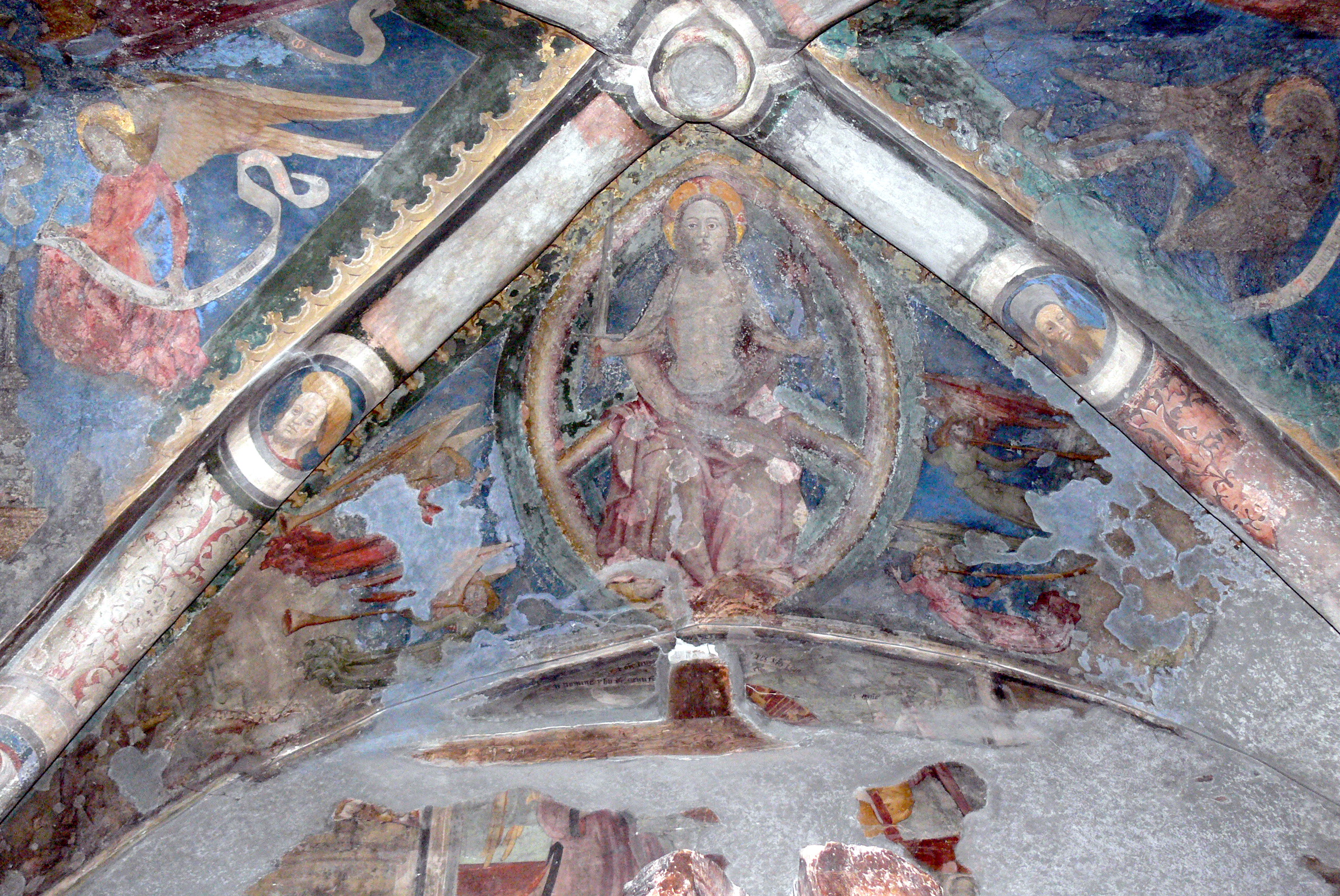
Fresco of Christ in Majesty (15th century )
Jesus' favorate self-designation wasn't "Son of God" or "Messiah"; rather, it was "Son of Man." Sometimes he used it when talking about his present earthly ministry, speaking of his authority over sin, sickness, or even nature (Wright, Knowing Jesus through the Old Testament, 150; citing Mark 2:10, 28). Sometimes he used it when speaking of suffering, rejection, dying, and rising again, all of which occur after the disciples had  begun to recognize that he’s the Messiah (Wright, Knowing Jesus through the Old Testament, 150; citing Mark 8:31; 9:31; Luke 9:44). But even more often, he used it when talking about his eschatological glory (Wright, 150; citing Mark 14:62; Matt 13:41-42; 19:28).

The Old Testament generally used "son of man" as a poetic expression for "man," "human," or "human being," often with emphasis on human weakness and mortality (Pss 8:4; 80:17; Isa 51:12; and 93x as a self-reference in Ezekiel). But in one place, it takes on the nature of a title (Daniel 7). There the "Son of Man" comes against the beastly kingdoms of this earth to strip them of their authority and crush them.

There we see a potential double point of reference for “Son of Man.” On the one hand, he could represent the saints, that is, all of God’s people throughout history (Dan 7:14 // Dan 7:18). He might do that as their angelic agent (cf. Dan 10:13, 20-21) or perhaps as a corporate representative of them all, which would go well with Jesus’ identification of himself with Israel.

On the other hand, the "Son of Man" might be associated with God himself (v. 13). He's given divine power and authority (v. 14). Indeed some Greek versions even identify the Son of Man with the Ancient of Days, an identification that Revelation echoes (Rev 1:7, 12-16).

In terms of either self-identification, Jesus made a great claim when calling himself "Son of Man." Either he claimed to represent the true people of God, or he claimed to be the one who would receive eternal dominion and authority to act in judgment. And he did that before the Sanhedrin. As Wright notes,
Strong stuff from one who had just been arrested at the dead of night and was himself on trial for his life. But there was worse. For in Daniel 7 the enemies of the son of man/saints of God were the beasts. Who then were these enemies of Jesus? As so often, Jesus did not need to spell out the implications of what he said to Jewish authorities. His meaning and its implied threat were clear and quite intolerable. Chief Priest or Chief Beast? No wonder Caiaphas tore his robes and cried blasphemy, called for the death penalty, and permitted the spitting and beating. The claims of Jesus were enough to burst blood vessels and well as old wine skins. (Wright, 153)

I draw two things from this:
  • Would that the church knew the Old Testament as well as Jesus' opponents! 
  • No matter how well you know the Scriptures, if you don't bow before the Lord of the Scriptures, you only condemn yourself.
________________

Chris J. H. Wright, Knowing Jesus through the Old Testament (Downers Grove, Ill.: InterVarsity, 1995) - Available from Amazon